Accidental Learning Update!
Guys - the last 3 days I've been totally obsessed and focused on learning more about and understanding better what I stumbled into over the past few weeks.
Although I am completely fascinated by what I've learned, the wife gives me an eye roll when I enthusiastically try and explain to her. LOL
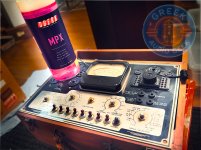
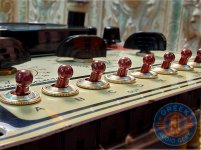
I've been restoring a 1930's Weston 774 that is the second worst faceplate I've ever encountered in terms of the amount and thickness of baked on dried into the porous paint oil, grime, nicotine and who knows what else that none of my go-to compounds would touch.
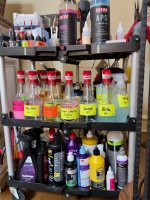
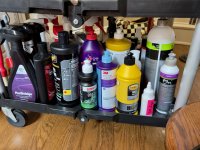
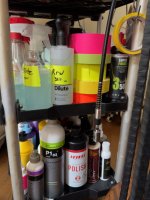
I tried a stack of products — Jescar's full line, Menzerna 1000/2500, Koch Chemie's fine and micro polishes, a couple of Meguiar's SMAT compounds and more. Nearly all of them either did nothing or just smeared the grime around without cutting it. Only a couple of products actually worked.
(Note I did initially try liquid cleaners and they didn't even make a dent in any of the grime that has hardened into a bullet-proof type cement).
That sent me down a rabbit hole, and the real breakthrough came by complete accident - the kind I find most exciting in this journey.
The accident: I sprayed a strong panel prep solvent on one of the testers to strip old product residue before working on it — something I'd used without issue on other testers. Within seconds, the black panel turned a faded, milky blue-grey. I thought I'd ruined it.
Turns out this is a well-documented phenomenon called
lacquer blush — a whitish, cloudy haze that forms when a fast-evaporating solvent reacts with a nitrocellulose lacquer paint. Nitro lacquer never fully cross-links, even after decades — it stays chemically "alive" in a way other finishes don't. That's the whole reason it can be reamalgamated (redissolved and reflowed with solvent to heal crazing), but it's also why it's vulnerable to this reaction from products that were never designed with it in mind.
So I've spent days studying up on nitro lacquer as most of the other testers I have do NOT have that finish and learning about how to deal with them.
Thankfully a light mechanical polish pulled the blush out — but I learned
almost every polish, compound, and glaze marketed today is built and tested against modern automotive paint systems, even when the label says "single-stage" or "all paint types." That language almost always means modern single-stage urethane, not 90-year-old nitro lacquer. As I just learned they're not the same chemistry.
What actually turned out to matter, mechanism-wise:
- Diminishing abrasive compounds (most modern cutting compounds — Menzerna, Jescar) are designed to break down under machine-generated heat and pressure. By hand, without that heat, many of them just don't fully engage — they smear rather than cut. One exception: I found that working a diminishing compound feverishly by hand in a much smaller section, for much longer than feels natural, can actually get it to work by hand. It's slow, but it's real.
- Fixed-abrasive "SMAT"-style compounds (Meguiar's M100, M105, M205) are often marketed as more hand-friendly than diminishing compounds, and in theory they should be. In practice I found they also didn't do too well. I don't have a clean explanation for why other than the finish is so old and fragile and also as I learned nitro actually dries out and needs to be revitalized. But I first need to clean it to be able to revitalize it.
- Solvent-forward products — sprays, panel preps, some "chemical + mineral" compounds — carry real blush risk. Heavier, slower-evaporating carriers (like the kerosene-type naphtha in some paste compounds) seem much less likely to trigger it than fast-flash solvents like isopropyl alcohol. The water based compounds I tried did not have the ability to even touch the grime so the grime still needs solvent to break it down.
- Oil-based "rejuvenating" glazes (Meguiar's #7 and similar) have a positive history on single-stage automotive paint. So after I am able to clean the grim off I'm going to be using M03 - a cousin of the #7.
What's actually worked for me, so far:
- Farécla G3 and G6 paste compounds — older abrasive technology by Farécla's own admission, explicitly positioned for aged and very aged paint. Hand-safe, no water needed, no staining issues like some 3M compounds - which are darker in color - are notorious for.
- 3M Rubbing Compound 05973 — the one product I found with an explicit "safe on lacquer and enamel" claim in its own documentation, not just "all automotive finishes." Confirmed cutting my actual grime by hand but the finish is so soft and dried out will definitely need a finishing and glaze step to remove polishing scratches.
- Menzerna 400, worked hard in small sections — a genuine diminishing compound that does work by hand if you give it the technique it needs. However it left a *slight* blush from the solvents in it. So I've ordered the non-solvent version to try. So far the best performing.
- Currently testing Meguiar's M02 (explicitly marketed for "older lacquer and enamel paints" — a real, written claim rather than inference), Meguiar's M03 Glaze and Menzerna 2400 (Menzerna's own FAQ singles this out as one of the few products in their range they explicitly recommend for hand use, and describes it as built for old, dry, "sticky" paint specifically).
The big takeaway: Holy crap is this far more complicated - and exciting - than I ever thought it would be!
Picture of it still trying to fight the grime without destroying the paint.