New Vintage Audio Restoration HQ

Thanks. I usually end up doing ti first thing in the morning, then in-between meeting through out the day. Often times I'll end up doing real work till 8 at night to make up for the time I played during the day. It also helps I work 7 days a week so it allows me flexibility generally during my day.
I try to keep up with the dishes...
 
Last edited:
Just received!

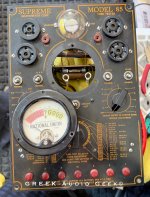
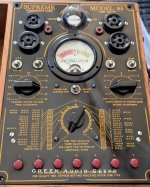
Refinishing steps:

1) test to see if powers up and can set line adjust to center;
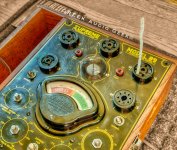
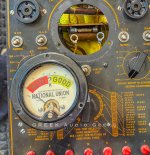
2) clean sockets using a pipe cleaner with evaporative contact cleaner (as shown in photo);
2A) take knobs off and clean and lube each switch and potentiometer;
3) test known tubes to see if works;
4) Inspect, test and update internals;
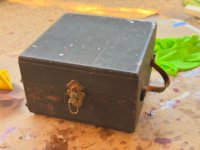
5) strip and refinish case;
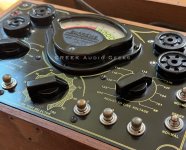
6) refinish the face plate (see second photo to compare how I get the scratches out. The second photos faceplate was as scratched as the top photo prior to my refinishing it).

5 3 sm.jpg
8.jpg
 
Sometimes 80 year old gear smells a bit stale.

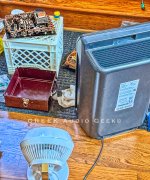
Solution: open them up and put a fan and air purifier on them for 24 hours. :)

Air purifier.jpg
 
  • Like
Reactions: JDC
I still think you have too much free time :)
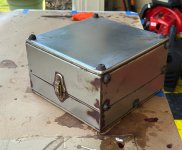
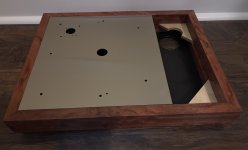
This is what I did today - I stripped the metal case of a 1947 tube tester that was rusty and beat up to refinish it. I need to finish sanding tomorrow.

I'm going to first put on an etch primer, then a sanding primer to level set, then paint.

IMG_0831.jpeg
IMG_0837.jpeg
 
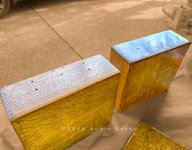
Two 1935 cases stripped and refinished.

  1. The one on the left is 15+ payers of French polishing (I'm teaching myself how to do that), topped with a hand applied wax;
  2. The one on the right is 8 layers of brushing lacquer then sanded up at 1500, 2500, 3000, 5000 and 8,000 grit.

5.jpg
 
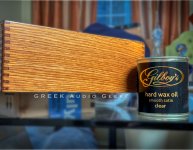
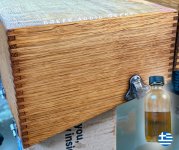
Three layers of hand rubbed Hard Wax Oil applied to this case on a 1935 Supreme Type 85 tube tester.

Took 6+++ hours to chemically strip and sand back 90 years of old finish and grime to get the wood clean enough to accept a new finish. I sanded it much higher this time as an experiment - I went up to 600 grit vs. the recommended 220 grit maximum.

I did my own one-off technique for applying this oil:

  1. Apply and deeply rub in with a 3M white non-woven pad;
  2. Then immediately lightly scrub the finish with Mirka 1500 grit non-woven pad which both further pushes the oil into the grain and also helps smooth the wood at the same time;
  3. Then immediately lightly wipe off any excess finish. This ensures the finish is "in the wood" rather than sitting on top of the wood where it will stay a gummy mess.
wood refinishing - Gilboys - Osmo.jpg
 
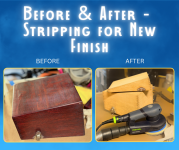
Didn't like how my finish came out so I spent 8 hours stripping it off back to bare wood on tis 1934 case.

I think I may try Tried & True Original hard was oil on this one. Or I may go with my favorite Liberon Finishing Oil and to pit with a wax.

Before & After - Stripping for New Finish.png
 
Pretty crazy three hours spent.

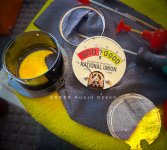
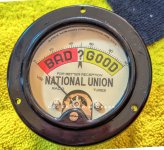
The most recent 1935 unit came with the glass dislodged from the ring and resting on the needle - meaning the needle was impeded AND the glass could break at any time.

I tried to use a suction cup to lift it and cement it in place and that didn't work.

Ended up having to completely remove it from the unit, take it apart, strip the cement that didn't work, clean 90 years of gunk, and reassemble.

Success!!

Before, during and after pics:

ba1.jpg
a1.jpg
a3.jpg
 
That's the only way to do it with meters like that. I know exactly what you went through; the meters we use are built to the original 1934 spec by the same manufacturer that made them back then as now.

Good work! That stuff can be really scary.
 
Good work! That stuff can be really scary.
Thanks Ralph.

There were several times I thought "what have I gotten myself into" by taking it apart.

However the great sense of accomplishment was only beaten by the amazement I was actually able to repair it and didn't break the glass. LOL
 
Back
Top