Michaels HiFi
Well-known member
- Thread Author
- #61

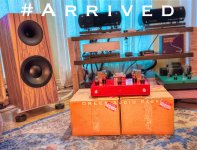
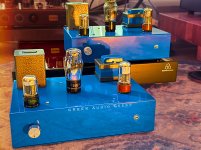
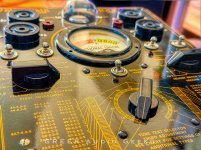

Thanks!Hey Michael great photography!!! Do you mind going over your setup please?

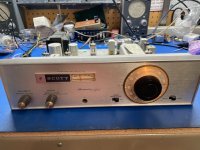
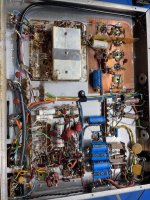
That's really interesting. Thank you for sharing the details.This is an HH Scott stereo FM tuner I picked up recently. It sort of worked; you could tune stations but didn't hear anything other than about a 400Hz tone, as if everyone on the dial suddenly were broadcasting tones instead of music.
Obviously the power supplies had to be rebuilt, but they were actually working. Note the filter cans in front of the power transformer. They are of such a value that there really isn't anything out there with which to replace them. So I had to get creative, in addition to sorting out why it wouldn't play. HH Scott tuners tend to be very stable IMO due to the IF (Intermediate Frequency) transformers being very well built (the square cans the same height as the tubes). Some of the Dynaco IF transformers from this period (FM-1, FM-2 and 3) have come unglued so you have to check them before attempting alignment; not so with the Scotts I've seen. So when you align the Scott, to tends to stay that way. This isn't the best tuner Scott made (their best one simply has an additional IF stage), but its not bad. I prefer it to the Dynaco and it gives some of the Mac tuners of the same period a run for the money.
View attachment 35035
View attachment 35036
I was able to fit the correct values, using individual parts, in the power supply. I cut off the terminals to the filter cans so they couldn't get in trouble but left the cans in place so they would look the part and not have the chassis look scarred. I cleaned up the wiring too- it was a bit sloppy. In the process found a bad connection feeding the filaments for the multiplex unit (the circuitry in the lower left) but that was not why it didn't play.
I had a good signal at the input of the mpx unit. So I traced it; the 38KHz subcarrier was present. I peaked its amplitude by aligning the various mpx transformers (which are all air-core, like the IF transformers) from one stage to the next. Turned out the tone I was getting was caused by the local oscillator (which is supposed to to sync to the incoming subcarrier) which was out of alignment so was beating with the incoming signal. So I nulled that and after that the tuner was playing quite well.
I aligned the front end and cleaned the bearings of the tuning capacitor. That sorted out the slight bit of noise that would occur when a station was being tuned in. Now it seems to work quite well. Next is to sort out the cabinet, which is missing the brass trapezoidal cover in the back.
Yes it is.That's really interesting. Thank you for sharing the details.
Before I go poking around in the tube testers I've been trying to make sure I do it safely. I saw this video on how to safely discharge capacitors.
With your expertise, is this legit?
Thank you. I'm trying to learn the right and SAFE way to fix them up.Yes it is.
Surprising to see in the opening minute, a Simpson 260 VOM sitting in the background on the left. I had several of those back in the 70s but when the digital Voltmeters showed up there was no looking back.

Thank you for the info and again great photography.Thanks!
I have a Canon C70 cinema camera and believe it or not of the dozens of lenses I have tried, I ended up on vintage film 1970's Pentax lenses on the expensive camera. It gives a unique look that modern lenses tend to lack. I use it for both video and photography. I only use prime lenses and never zoom lenses.
For lighting I have everything from a hand held LED that changes colors with a home made diffuser on it to a big giant LED 600 watt studio lights. Diffusors are key to any good lighting. In fact often times I actually bounce the light off a white poster board onto the subject itself for a more unique and diffuse lighting. Direct lighting is almost always bad, while defused and indirect lighting is almost alway preferable (sometimes though I break that rule and try to incorporate lighting through a window onto a subject for a unique lighting effect).
But for the most part the videos require a different kind of lighting than the photos.
I usually will put the piece I want to photograph in my room where I work. I will glance over at it repeatedly over several days (sometimes just staring at it) and suddenly a certain bit of sun hitting it, or angle or inspiration suddenly hits me and I "see" the photo itself so I take it.
I've been trying to learn how to always look at objects as if I am looking through a lens and learning composition. It was something the books I read to talked about and I never understood it, but through practice it finally happens. My photographic inspiration is from a type of photography called street photography - that's where people walk around cities and try and catch unique photos as they see them vs. just taking a normal picture of a monument or something. Rather than trying to "place" objects into a perfect staged setting, I prefer to try and capture them in a normal everyday position or set up. It feels more interesting to me.
But generally speaking I like to use natural light to its fullest and try and capture subjects that way. At most maybe I'll use my small diffused hand held light for just a bit of front lighting to either offset strong back lighting or to add a contrasting color for effect.
I've spent literally hundreds of hours trying to learn from others how to be a better photographer and enjoy experimenting with it.

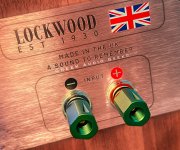

What material used ..?Picture of the made-in-house binding posts on the Lockwood speakers I have here now.
View attachment 35061
Brass.What material used ..?