
You are using an out of date browser. It may not display this or other websites correctly.
You should upgrade or use an alternative browser.
You should upgrade or use an alternative browser.
What type of speaker still sounds good at low listening levels?
- Thread starter Ricky64
- Start date


a.wayne
Well-known member
Hahahahaha 

Dr Morbius
Active member
- Joined
- Jun 14, 2016
- Messages
- 225
That is a true statement!Some people can only be "high volume" listeners when their wives aren't home.
stereogeek
Member
- Joined
- Mar 15, 2018
- Messages
- 480
Last time I really cranked it up, I set off the burglar alarm. The wife was not happy`. The Volti's get loud and dynamic as heck on 25wpc....lol. But, they are also really good at low volume too. Cheers.

Swen Hornsolutions
New member
- Joined
- Sep 13, 2025
- Messages
- 7
Of course fully horn-loaded horn loudspeakers, where the entire driver is acoustically coupled to an exponential or tractrix horn, offer distinct advantages over direct-radiating or hybrid designs, particularly at low sound pressure levels (SPLs). This superiority stems from their exceptional efficiency and acoustic loading, which enhance both macro- and microdynamics.
At the core is efficiency: Horns achieve conversion rates of 10-40% of electrical input to acoustic output, far surpassing the 0.5-2% typical of conventional dynamic drivers. This high sensitivity (often 100-110 dB/W/m) means that for a given low SPL—say, 40-60 dB—horns require minimal amplifier power, often milliwatts. Conventional speakers, with lower sensitivity (80-90 dB/W/m), demand more current to reach the same volume, driving the voice coil harder and introducing nonlinear distortions like intermodulation (IMD) and harmonic distortion (THD), which mask subtle details.
This leads to superior dynamics. The horn’s acoustic impedance match provides back-loading to the driver, stiffening its response and reducing cone excursion at low levels. Consequently, the system maintains a wide dynamic range (up to 120 dB) without compression, allowing effortless transitions from silence to peaks. At low volumes, this preserves transient accuracy, as the driver’s damping is enhanced, minimizing resonances.
Microdynamics—the nuanced rendering of small amplitude variations, like a pianist’s subtle touch—benefits most. Low-power operation keeps the driver in its linear region, where voice coil mass and suspension exhibit precise control, capturing micro-inflections without veiling. In contrast, direct radiators at low SPLs suffer from partial cone breakup or magnetic hysteresis, blurring these subtleties.
In essence, fully horn-loaded designs transform low-volume listening into a revelation of texture and space, ideal for critical applications like classical music reproduction.
Best Regards S
At the core is efficiency: Horns achieve conversion rates of 10-40% of electrical input to acoustic output, far surpassing the 0.5-2% typical of conventional dynamic drivers. This high sensitivity (often 100-110 dB/W/m) means that for a given low SPL—say, 40-60 dB—horns require minimal amplifier power, often milliwatts. Conventional speakers, with lower sensitivity (80-90 dB/W/m), demand more current to reach the same volume, driving the voice coil harder and introducing nonlinear distortions like intermodulation (IMD) and harmonic distortion (THD), which mask subtle details.
This leads to superior dynamics. The horn’s acoustic impedance match provides back-loading to the driver, stiffening its response and reducing cone excursion at low levels. Consequently, the system maintains a wide dynamic range (up to 120 dB) without compression, allowing effortless transitions from silence to peaks. At low volumes, this preserves transient accuracy, as the driver’s damping is enhanced, minimizing resonances.
Microdynamics—the nuanced rendering of small amplitude variations, like a pianist’s subtle touch—benefits most. Low-power operation keeps the driver in its linear region, where voice coil mass and suspension exhibit precise control, capturing micro-inflections without veiling. In contrast, direct radiators at low SPLs suffer from partial cone breakup or magnetic hysteresis, blurring these subtleties.
In essence, fully horn-loaded designs transform low-volume listening into a revelation of texture and space, ideal for critical applications like classical music reproduction.
Best Regards S

still-one
Well-known member
I can tell you that Wilson's, MBL, B&W, Von Schweikert, and Focal to name a few do not sound good at lower volume levels. They may not sound bad but I never found real enjoyment until a certain sweet spot was reached on each.
Dr Morbius
Active member
- Joined
- Jun 14, 2016
- Messages
- 225
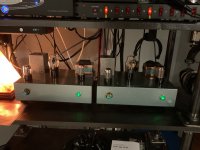
a.wayne
Well-known member
Horns do macro very well , poor on Micro , they dont scale down and up as good as Direct radiators..!Of course fully horn-loaded horn loudspeakers, where the entire driver is acoustically coupled to an exponential or tractrix horn, offer distinct advantages over direct-radiating or hybrid designs, particularly at low sound pressure levels (SPLs). This superiority stems from their exceptional efficiency and acoustic loading, which enhance both macro- and microdynamics.
At the core is efficiency: Horns achieve conversion rates of 10-40% of electrical input to acoustic output, far surpassing the 0.5-2% typical of conventional dynamic drivers. This high sensitivity (often 100-110 dB/W/m) means that for a given low SPL—say, 40-60 dB—horns require minimal amplifier power, often milliwatts. Conventional speakers, with lower sensitivity (80-90 dB/W/m), demand more current to reach the same volume, driving the voice coil harder and introducing nonlinear distortions like intermodulation (IMD) and harmonic distortion (THD), which mask subtle details.
This leads to superior dynamics. The horn’s acoustic impedance match provides back-loading to the driver, stiffening its response and reducing cone excursion at low levels. Consequently, the system maintains a wide dynamic range (up to 120 dB) without compression, allowing effortless transitions from silence to peaks. At low volumes, this preserves transient accuracy, as the driver’s damping is enhanced, minimizing resonances.
Microdynamics—the nuanced rendering of small amplitude variations, like a pianist’s subtle touch—benefits most. Low-power operation keeps the driver in its linear region, where voice coil mass and suspension exhibit precise control, capturing micro-inflections without veiling. In contrast, direct radiators at low SPLs suffer from partial cone breakup or magnetic hysteresis, blurring these subtleties.
In essence, fully horn-loaded designs transform low-volume listening into a revelation of texture and space, ideal for critical applications like classical music reproduction.
Best Regards S
Large direct radiators in a domestic environment gives up nothing to horns IMO , the biggest problem with audiophiles buying direct radiators is they very rarely ever attempt to match the speaker load to their amps in the same way horn people take the time to match their amps/speakers .
This lack of Synergy is the big downfall comparing setups …
Regards
PS: direct radiators will achieve 1
acoustic watt with 50watts while horns will need 7 watts or so , this was an issue in 1950 not so since amps advanced past 50 watts per channel with low thd ..!
Now to deal with those pesky deep throat reflections and coloration issues .
Last edited:

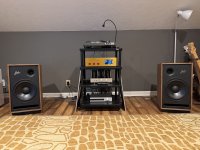
Pylon Jade 20

Horns are undoubtedly (in my experience) the best TYPE of speaker for high level of detail at low volume. My speakers are 18 ohm and 107 dB so easy for any amplifier, valve or ss, and detail at low volumes is exceptionalHorns do macro very well , poor on Micro , they dont scale down and up as good as Direct radiators..!
Large direct radiators in a domestic environment gives up nothing to horns IMO , the biggest problem with audiophiles buying direct radiators is they very rarely ever attempt to match the speaker load to their amps in the same way horn people take the time to match their amps/speakers .
This lack of Synergy is the big downfall comparing setups …
Regards
PS: direct radiators will achieve 1
acoustic watt with 50watts while horns will need 7 watts or so , this was an issue in 1950 not so since amps advanced past 50 watts per channel with low thd ..!
Now to deal with those pesky deep throat reflections and coloration issues .
a.wayne
Well-known member
Define low volume ..?
Dr Morbius
Active member
- Joined
- Jun 14, 2016
- Messages
- 225
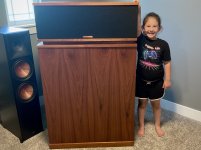
High level of detail at low volume, I have to agree with my Klipschorn’s, that’s a fact and with my wife sleeping in the next room I have to play nice. I haven’t measured the db output but it’s very quiet….I wish my wife wasn’t such a light sleeper!
Here’s my 6 year old granddaughter helping me move the K-horn into the corner.
Here’s my 6 year old granddaughter helping me move the K-horn into the corner.
Attachments
Dr Morbius
Active member
- Joined
- Jun 14, 2016
- Messages
- 225
Define low volume? - 65 to 70db is how I would define it.
Last edited:

Kingrex
Well-known member
I like horns. I am using a hybrid horn/open baffle. The problem with all horn is to get to low hertz, the horn has to be massive. Maybe 20 feet in length. That is a massive structure in a room. A 12 inch driver in a 14 x 14 box can get to 20 hertz. Sure it takes 2000 watts to power it. But the size in diminutive in comparison.
I have a horn sub. Its pretty big. I think about 22x22x26. It only gets to 45 hertz. Its outstanding. But its not really a sub. Its a bass extension designed to support a true horn midrange. To get low, you need massive. Or you need a sealed box and lots of power.
How does that relate to good sound at low volume. Balance. As others have said. You need the correct amp for the speaker. I have heard a little Raidho X5 sound amazing. It had a massive boulder amp driving it. I have heard a large horn sound great. It had 3 watts of 45SET powering it. I am still working my speakers. I have 40 watts driving the horn and I'm getting another 600 watts to drive the mid bass and woofers. I don't have enough power with just 40 watts to the whole shebang. I have to turn it up to say 67db for it to start to come alive. Below its flat. Its much better at 76 db.
I have a horn sub. Its pretty big. I think about 22x22x26. It only gets to 45 hertz. Its outstanding. But its not really a sub. Its a bass extension designed to support a true horn midrange. To get low, you need massive. Or you need a sealed box and lots of power.
How does that relate to good sound at low volume. Balance. As others have said. You need the correct amp for the speaker. I have heard a little Raidho X5 sound amazing. It had a massive boulder amp driving it. I have heard a large horn sound great. It had 3 watts of 45SET powering it. I am still working my speakers. I have 40 watts driving the horn and I'm getting another 600 watts to drive the mid bass and woofers. I don't have enough power with just 40 watts to the whole shebang. I have to turn it up to say 67db for it to start to come alive. Below its flat. Its much better at 76 db.
a.wayne
Well-known member
Hahaha , good levels , high for Classical soft passages for sure , normal for other genre’s ..!Define low volume - 80 to 85db is how I would define it.
a.wayne
Well-known member
Small boxes produce really poor Bass/Low Bass vs a large version ..I like horns. I am using a hybrid horn/open baffle. The problem with all horn is to get to low hertz, the horn has to be massive. Maybe 20 feet in length. That is a massive structure in a room. A 12 inch driver in a 14 x 14 box can get to 20 hertz. Sure it takes 2000 watts to power it. But the size in diminutive in comparison.
I have a horn sub. Its pretty big. I think about 22x22x26. It only gets to 45 hertz. Its outstanding. But its not really a sub. Its a bass extension designed to support a true horn midrange. To get low, you need massive. Or you need a sealed box and lots of power.
How does that relate to good sound at low volume. Balance. As others have said. You need the correct amp for the speaker. I have heard a little Raidho X5 sound amazing. It had a massive boulder amp driving it. I have heard a large horn sound great. It had 3 watts of 45SET powering it. I am still working my speakers. I have 40 watts driving the horn and I'm getting another 600 watts to drive the mid bass and woofers. I don't have enough power with just 40 watts to the whole shebang. I have to turn it up to say 67db for it to start to come alive. Below its flat. Its much better at 76 db.
45 hz is not considered playing sub bass ..!
Regards
Kingrex
Well-known member
Agree. Thats why I said its really the bass for a midrange horn.Small boxes produce really poor Bass/Low Bass vs a large version ..
45 hz is not considered playing sub bass ..!
Regards
If you wanted that X5 Raidho to be full range, you would need subs.
I have a pair of Fritz Carbon speakers that Fritz sent me for review. They sound pretty good at low levels but electronics also play the part. Van Alstine gear typically sounds good at low volumes. So did the Pass X1 preamp that I had. I sold it to buy a BAT VK51se tube preamp to pair with my X250 Pass amp. The BAT was way better, more dynamic and musical but the X1 sounded so much better at low volumes.

88Keys
New member
- Joined
- Nov 26, 2025
- Messages
- 15
My typical listening volume is between 60-75 dB, which is not particularly loud, and my Sonus Fabers sound great at that level. I only occasionally hit 80dB according to my decibel meter, and that level is usually with a powerful pipe organ or massive climax in a symphony. I listen mostly to classical music.