The Sandman
Active member
Speakers that sound good loud shouldn’t sound bad at low listening levels. It’s more a question of how quiet your room is and how low you’ve managed to get the noise floor of your system.


Speakers that sound good loud shouldn’t sound bad at low listening levels. It’s more a question of how quiet your room is and how low you’ve managed to get the noise floor of your system.
Agree. My Fynes are 90 or 91 dB, not bad, with two RELs, but I have to admit they sound better when it's cranked up..It's all about sensitivity and impedance. Low sensitivity/low impedance speakers require more power and current to come to life. It's not that they sound "bad" at low levels, they just don't jump to life as fast as high sensitivity/high impedance speakers do.


My hypothesis:
At low listening levels, the Fletcher-Munson equal-loudness curves (how our ears perceive bass and treble differently at quiet volumes) matter more than the type of speaker. Horns and high-sensitivity designs can sound more lively at low volume because they preserve dynamics and stay clear near the amp’s noise floor — but they don’t fix the ear’s natural loss of bass and top-end at low SPL.
If you apply proper loudness-compensation EQ, almost any well-engineered speaker can sound full and balanced at quiet levels.
Psychoacoustics dominates; equipment choices just help work around it.
I believe the psychoacoustic realities are a much bigger impact than the equipment wrt the OPs question.Loudness buttons that used to be prominent many years ago on receivers and integrated amps have all but disappeared.
High sensitivity/high impedance speakers don't need help jumping to life at low levels (meaning your volume control doesn't have to be turned at least halfway up before your speakers come to life along with your wife).
Therefore I disagree with your premise that low sensitivity/low impedance speakers are really not different from high sensitivity/high impedance speakers. High sensitivity/high impedance speakers don't need the punch from a non-existant loudness button to come to life.
I believe the psychoacoustic realities are a much bigger impact than the equipment wrt the OPs question.
 How to Read It
Sure.
Here you go!
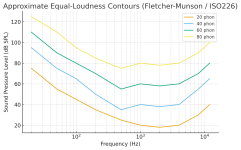
This plot shows approximate equal-loudness (Fletcher–Munson / ISO-226) contours — lines of constant perceived loudness across frequency.
Each contour (20, 40, 60, 80 phon) represents sound that humans perceive as equally loud, even though the required SPL changes with frequency.
Key Takeaways:
This is the foundation of and the reason for:
- Bass requires MUCH more SPL to be heard as loud as midrange at low listening levels
→ look at the left side of the curves (20–200Hz)- The ear is most sensitive around 2–4kHz
→ the dip in the curves- As listening level rises (40 → 60 → 80 phon),
the curves flatten
→ this is why music sounds fuller and more balanced at higher volumes
And why equipment choice matters less than psychoacoustics when listening quietly.
- loudness compensation
- dynamic EQ
- “thin” bass perception at low volume
Psychoacoustic is a fancy way of describing our hearing at different SPL levels…
For sure. But since it’s the science of how we perceive sound, I thought it fitting. Here’s a few semesters of learning from a few key strokes. Crazy AI!! Enjoy ALL!Psychoacoustics means much more than just "describing our hearing at different SPL levels." That's why I asked you to elaborate.
 What Is Psychoacoustics?
 Core Principles Relevant to Audio Reproduction
 Psychoacoustics in High-End Listening
 Psychoacoustics explains common experiences
 Final Summary
 Primary Academic Sources Equal-Loudness & Fletcher-Munson Psychoacoustics (General, Foundational Texts)
 Psychoacoustics: Facts and Models (2nd Edition). The Science of Sound (3rd Edition). An Introduction to the Psychology of Hearing (6th Edition). Masking & Critical Bands
 Time-Domain Sensitivity & Temporal Resolution Localization & Spatial Imaging Spatial Hearing: The Psychophysics of Human Sound Localization (Revised Edition).
 Harmonic Content, Timbre, & Perception
I particularly enjoyed the section on Masking and why properly integrated subs help clear up midrange sound. There is actual science behind this stuff.

Yes. It’s a wonderful tool.