New Vintage Audio Restoration HQ

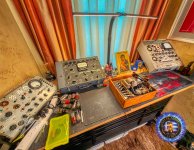
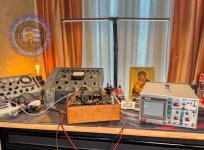
This is the unit I paid $100 to an EE to get running and he failed to get it running.

After I spent some time with it, poking around, and changing some things, this happened.....


This is the unit I paid $100 to an EE to get running and he failed to get it running.

After I spent some time with it, poking around, and changing some things, this happened.....


Most of the tube testers I've seen have had really minor problems, mostly due to age. Some of them are difficult just because of figuring out how to use them (especially older ones like this)!
 
Most of the tube testers I've seen have had really minor problems, mostly due to age. Some of them are difficult just because of figuring out how to use them (especially older ones like this)!

It's interesting, starting to deal with these things I feel like I learned there are different ways of looking at this gear.

I think there is traditional electronics fixing and then what I'm calling "vintage" electronics fixing. It's almost two different ways of looking at the electronics and fixing potential problems.

For instance one of my testers I received would not read 45 tubes. I think many would open up the unit and start trouble shooting (I would have). My old tube buddy friend (he used to work on tube testers in the Navy) instead had me simply stick a pipe cleaner sprayed with QD cleaner in the 4 pin socket on the tester without opening anything.

Bingo, it worked wonders.

I bet with everything you've worked on you approach it a similar way.
 
It's interesting, starting to deal with these things I feel like I learned there are different ways of looking at this gear.

I think there is traditional electronics fixing and then what I'm calling "vintage" electronics fixing. It's almost two different ways of looking at the electronics and fixing potential problems.

For instance one of my testers I received would not read 45 tubes. I think many would open up the unit and start trouble shooting (I would have). My old tube buddy friend (he used to work on tube testers in the Navy) instead had me simply stick a pipe cleaner sprayed with QD cleaner in the 4 pin socket on the tester without opening anything.

Bingo, it worked wonders.

I bet with everything you've worked on you approach it a similar way.
Its been different over the years. It used to be that when restoring an old radio or tube amplifier all you had to do was replace filter capacitors. These days you have to go over the whole thing because so may coupling caps have rotted and resistors are miles off value.
In this amplifier
NS-130.jpg
oddly, all the coupling caps were good, but nearly all the resistors had drifted off value. Its worth noting that this amplifier had sat for decades in a warehouse in Canada, unused. Allegedly was NOS and came with the paper covers for the transformers a bit rotted but still intact. So my surmise is the resistors drifted off value without any use. But the amp is 68 years old. A lot of corrosion can occur in that time...
 
Making progress.

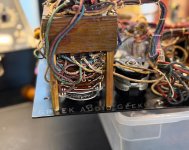
I've not got it powering up so I'm working more on the super stiff pot.

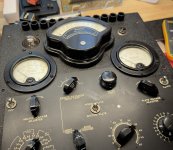
You can see it in this pic with a temp knob on it.

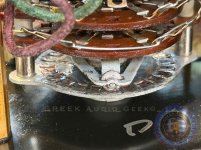
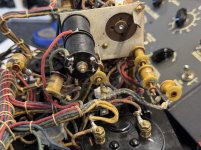
I decided to turn the multi-layer switch upside down and that helped me see part of the problem - the wiper on the underside of the top most layer was corroded and such.

So I hit that with some DeOxit and a pipe cleaner to scrub it clean a bit and have been turning it till my fingers are sore.

I also hit each layer where the shaft goes all the way though with a drop of Kroil and will let that sit over night.

Then I'm going to check the resistors to see if they have drifted over time.

IMG_2508.jpeg
IMG_2509.jpeg
IMG_2510.jpeg
 
Making progress.

I've not got it powering up so I'm working more on the super stiff pot.

You can see it in this pic with a temp knob on it.

I decided to turn the multi-layer switch upside down and that helped me see part of the problem - the wiper on the underside of the top most layer was corroded and such.

So I hit that with some DeOxit and a pipe cleaner to scrub it clean a bit and have been turning it till my fingers are sore.

I also hit each layer where the shaft goes all the way though with a drop of Kroil and will let that sit over night.

Then I'm going to check the resistors to see if they have drifted over time.

View attachment 35370
View attachment 35371
View attachment 35372
The switch doesn't look bad at all!
 
The switch doesn't look bad at all!
It's slowly getting better thankfully.

The main wiper arm is a double wiper arm and sits about a 1/4 inch right under the black faceplate (you can see it partially in the first pic).

Hopefully after tonight's cleaning it will be good to go.
 
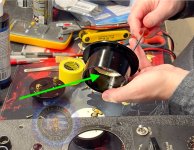
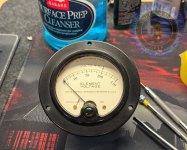
I spent three hours on this one gauge yesterday.

The glass was up against the needle so I disassembled to fix.

All went well - up to a point.

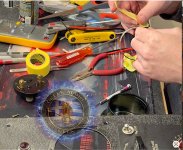
You can see in the photo I choose to put tape around the outside of the metal ring that then slides up against the glass to keep it secure which made the fit tight again within the metal gauge cylinder.

I also took the time to clean the glass. Needed to use super fine car polish to get the glass clean as no glass cleaner was strong enough to remove 90 years of grime.

I choose not to use glue to secure the ring in case I ever broke the glass and needed to disassemble it, glue would have prevented that.

The issue?

That little piece that is about 1/8th on an inch wide that sticks out to be able to adjust the gauge needle didn't want to go back. Evidently this one was plastic (unlike my other one that was metal) so it was deformed.

I finally got it back together and not sure if I'll be able to use the set screw to zero the needle.

Solution?

I ordered an entire gauge off Ebay for $14. It's not the right needle reading but it's the exact same unit so I'll simply use the little pin off the replacement if need be. Now I also have spare tiny gauge screws and glass for the future.

First pic is when I started and last pic is finished gauge.

1.jpeg
a2.jpga3.jpgA4.jpg
 
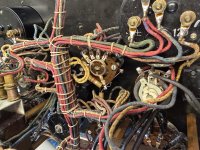
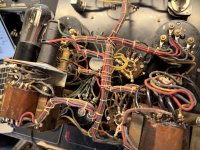
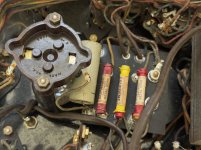
Well, I spent 4 hours on this yesterday going through the resistors, caps and checking all the wiring connections.

Believe it or not, some of the resistors (all mil-spec) were still within tolerances!

Regardless, I made a list and ordered all new ones today to replace anyway. Even the ones supposedly still in spec are getting changed out.

When the resistors only cost 50 cents each, it doesn't make sense to not replace them. Plus by the time I de -older one end out of circuit to test it I may as well simply do both and install a new part. The wire wound resistors were the most expensive at a couple of bucks each and I needed a handful of them.

I used AI to help me review the manuals for the TV-10, Supreme 85, Supreme 89, NRI 70 and Weston OQ-2 and make sure I ordered all the right parts and upgraded most of them to even tighter tolerances than was factory.

By the time I ordered parts for all 4 testers, new fuses and more, and paid shipping and tax it only came to $90.

Every one on the TV-10 tested in spec but I am still replacing all the parts in the primary critical path and leaving the resistors that tested in spec in the harder to reach places alone.

Am also upgrading the cap on the meter movement to make sure that is protected and accurate.

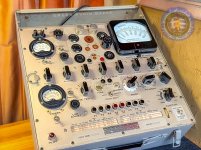
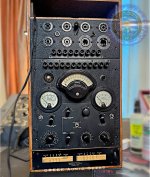
Pictured is the Weston OQ-2 from 1939. I enjoy the older testers as they are usually a bit more simple and easier for me to learn on. After 7 hours I got the potentiometer seemingly working and I rebuilt the meter as shown in pics above.

IMG_2547.jpeg

IMG_2540.jpeg
 
I spent three hours on this one gauge yesterday.

The glass was up against the needle so I disassembled to fix.

All went well - up to a point.

You can see in the photo I choose to put tape around the outside of the metal ring that then slides up against the glass to keep it secure which made the fit tight again within the metal gauge cylinder.

I also took the time to clean the glass. Needed to use super fine car polish to get the glass clean as no glass cleaner was strong enough to remove 90 years of grime.

I choose not to use glue to secure the ring in case I ever broke the glass and needed to disassemble it, glue would have prevented that.

The issue?

That little piece that is about 1/8th on an inch wide that sticks out to be able to adjust the gauge needle didn't want to go back. Evidently this one was plastic (unlike my other one that was metal) so it was deformed.

I finally got it back together and not sure if I'll be able to use the set screw to zero the needle.

Solution?

I ordered an entire gauge off Ebay for $14. It's not the right needle reading but it's the exact same unit so I'll simply use the little pin off the replacement if need be. Now I also have spare tiny gauge screws and glass for the future.
FWIW the glass on meters like that is usually glued in.
 
FWIW the glass on meters like that is usually glued in.
Yeah - I think all the glue is long dried up decades ago. The glass has been loose on all the ones I've received.

I know Murphy's law - the minute I glue it back it will break. :)
 
Back
Top