New Vintage Audio Restoration HQ

Those Western Electric horns are quite a sight! A local museum here in town called the Pavek Museum (any audiophile visiting Minnesota owes it to themselves to visit the place) was the first place I saw one of those. They played it with a WE 211 amplifier that sat in a relay rack. Definitely a speaker with the efficiency needed but no bass response. Of course that invites limiting the bass response of the 45 even further, if a different speaker were to be the woofer or subwoofer.

Those things are kinda big though- not usually the sort of thing you see in someone's living room ;)
 
Those Western Electric horns are quite a sight! A local museum here in town called the Pavek Museum (any audiophile visiting Minnesota owes it to themselves to visit the place) was the first place I saw one of those. They played it with a WE 211 amplifier that sat in a relay rack. Definitely a speaker with the efficiency needed but no bass response. Of course that invites limiting the bass response of the 45 even further, if a different speaker were to be the woofer or subwoofer.

Those things are kinda big though- not usually the sort of thing you see in someone's living room ;)

I keep telling my wife if we get rid of the couch, coffee table, side chair, and dinette table we'll have plenty of room for WE horns and appropriate bass modules. :)
 
I keep telling my wife if we get rid of the couch, coffee table, side chair, and dinette table we'll have plenty of room for WE horns and appropriate bass modules. :)
Good strategy! :)
I carved out a few more feet for my system (in our multi-use living room) a month or two ago. My stereo is separate from the TV on the other side of the room. We have no real desire for home theatre. Sooo, I managed to push the couch (slowly, over days) closer to the TV to make room for my subs on the outside of the main speakers. She didn't notice. When we are on the couch watching TV, I just say something like, "Isn't this big-screen TV great?"
 
Last edited:
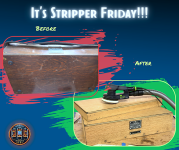
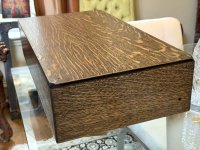
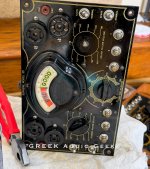
Here is the completely stripped 1940's US Navy tube tester I have with before and after photos.

Process:

- I first wipe with home-made solvent mixture to clean off the 85 years of grime;
- Then use 80 grit net abrasives to sand off much of the old finish. Regular sandpaper is useless;
- Apply and scrape off finish with several applications of Jasco finish stripper;
- Scrub several times with steel wool and solvent to clean off old stripper residue;
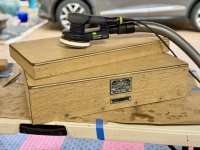
- Then spend 4-6 hours sanding it down with various grits of sand paper usually 80 grit, 120 grit, 150 grit and 180 grit;
- Then another scrub down with solvent and steel wool;
- Finally a final sanding with 180 net paper and a hand sand with the same 180 grit paper.

Now it's time to rest the back and arms and decide overnight which finish to apply tomorrow...

furniture refinish, woodworking.png
 
Here is the completely stripped 1940's US Navy tube tester I have with before and after photos.

Process:

- I first wipe with home-made solvent mixture to clean off the 85 years of grime;
- Then use 80 grit net abrasives to sand off much of the old finish. Regular sandpaper is useless;
- Apply and scrape off finish with several applications of Jasco finish stripper;
- Scrub several times with steel wool and solvent to clean off old stripper residue;
- Then spend 4-6 hours sanding it down with various grits of sand paper usually 80 grit, 120 grit, 150 grit and 180 grit;
- Then another scrub down with solvent and steel wool;
- Finally a final sanding with 180 net paper and a hand sand with the same 180 grit paper.

Now it's time to rest the back and arms and decide overnight which finish to apply tomorrow...

View attachment 35072
That yellow grained wood is gorgeous! Nice job indeed.
 
Update as of today:

I didn't like how light the wood was after cleaning. I knew if I simply applied an oil or wax finish it would slightly darken but take on a yellow hue based on the underlying wood color I did not want. So I decided to try something new.

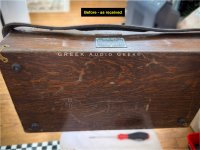
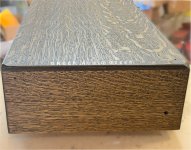
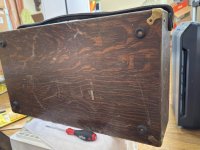
- I spent over 8 hours stripping and sanding the 1940's unit (photo 1 is as I received it);
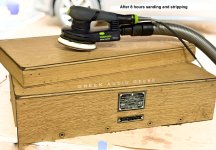
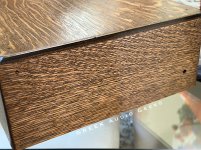
- Photo 2 is after doing all the sanding and stripping;
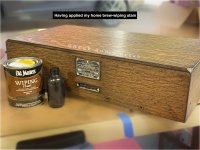
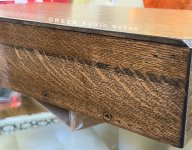
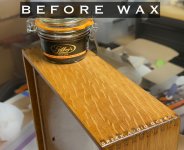
- Photo 3 and 4 is after I applied my home brew wiping stain I diluted. Photo 4 shows you can still clearly see the grain as I wanted. I was trying to highlight the grain, not cover it.

I applied the home brew DIFFERENTLY than most people would (I'll cover in a video) as I wanted a more transparent look PLUS I'm going to be going over it with an oil finish after it cures to add a touch of that oil 'warmth' to the grain and add a glow to it.

Redo 1.jpg
Redo 2.jpg
Redo 3.jpg
Redo 4.jpg
 
OK guys - latest update.

After applying my thinned version of the stain, I applied a mix I've really liked before: 1/3 Liberon Oil, 1/3 solvent, 1/3 oil poly.

HOWEVER, this time I replaced the Zar poly with a different brand, and in applying it on this piece I did NOT like how it looked. It made it look muted dull and lifeless.

So I course corrected after only 1 application of a normal 4 coat process: I did a light sanding to remove that top thin layer of oil/poly AND removed just a bit of the stain in order to increase the contrast within the existing grain.

Then I applied 3 super thin layers or Arm-a-seal. Normally I prefer a matte finish, but I think the gloss (which I hand rubbed after each coat and in-between coats to have an even semi-gloss sheen) really made the grain pop.

Here it is in the current state and I really like it. Remember this is a 1941-ish case so the wood is about 85 years old.

Grain 1.jpg


Grain 2.jpg
 
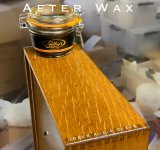
Before and After.

Photo 1 is BEFORE I added Rose Gold colored wax, but AFTER I applied my trifecta finish of 1/3 oil, 1/3 solvent, 1/3 Zar.

I wanted to see if it would add a darker color in the grain to help make it pop more.

Photo 2 is AFTER I applied a layer of Rose Gold wax and wiped it off with a special waffle type cloth. Why a waffle cloth? A normal cloth will create a bit of heat and simply smear the wax making it look a bit hazy. The open weave waffle style cloth removes the wax BUT stays cooler so it does not smear the wax.

It's subtle but more pronounced in person vs. camera. Adds a bit of dimension to it as well.


B1.jpg

B2.jpg
 
Have you got the tester working?
On that one I just received it back from someone who was working on it for me (it's a unique tester that is very complicated). He said he got it working except one of the potentiometers is frozen.

I'm going to tackle that over the next couple of days with penetrating oil and a bit of heat if need be.

I also have one of the 1930's Supreme's running and need to put it all back together and do my magic on the faceplate to clean it up.

This is the Supreme:

TT1.jpg
 
one of the potentiometers is frozen.

I'm going to tackle that over the next couple of days with penetrating oil and a bit of heat if need be.
If you can replace the part you will be far better off!

Penetrating oil may free the shaft from its bushing, but may also damage the element- be careful!!

Having dealt with older pots in tube testers before, it can be really frustrating to have worked on the part and reinstalled it, only to find the thing is flaky when you're trying to make an adjustment (such as setting bias). Its OK to put a new part in, just respect the kind of part it is (for example if a wire wound pot the new part should be wire wound too) and do your best to keep the wiring intact and as neat as possible.

Your tester has cloth covered wiring; there are sources for that so you can keep the right appearance inside.

BTW the best penetrating oil I've encountered so far is Kroil, which is about 1000x more effective than WD40. Its only available from the Kano Labs website. It really smells but its the best at freeing things that are frozen.
 
If you can replace the part you will be far better off!

Penetrating oil may free the shaft from its bushing, but may also damage the element- be careful!!

Having dealt with older pots in tube testers before, it can be really frustrating to have worked on the part and reinstalled it, only to find the thing is flaky when you're trying to make an adjustment (such as setting bias). Its OK to put a new part in, just respect the kind of part it is (for example if a wire wound pot the new part should be wire wound too) and do your best to keep the wiring intact and as neat as possible.

Your tester has cloth covered wiring; there are sources for that so you can keep the right appearance inside.

BTW the best penetrating oil I've encountered so far is Kroil, which is about 1000x more effective than WD40. Its only available from the Kano Labs website. It really smells but its the best at freeing things that are frozen.

I would normally agree with you. The challenge on this one is it's a multilevel 22 position switch that has 110 connections on it. I think trying to change that out would be beyond a nightmare.

I'll post a pic in a bit.
 
I’ve used Kroil before and yes it stinks but only in the olfactory sense, it really does penetrate and lubricate the best on the market.
Steve
 
I’ve used Kroil before and yes it stinks but only in the olfactory sense, it really does penetrate and lubricate the best on the market.
Steve

Thanks Steve. I actually bought some to try and this will be the first time me using it. Hopefully it works!
 
I knew it would work, congrats!
You were right. I haven't used it before and it really did work.

I unpacked the tester yesterday and it was still frozen solid. Figured I'd drop in a few drops overnight and I went to move it today so I could unpack the latest speakers I received.

I figured just for the heck of it I'd try it, never thinking it would work. I was stunned when it did! So I put in a few more drops and will let it sit over night.

Tomorrow I'll clean and lubricate it.
 
Back
Top