New Vintage Audio Restoration HQ

Those Western Electric horns are quite a sight! A local museum here in town called the Pavek Museum (any audiophile visiting Minnesota owes it to themselves to visit the place) was the first place I saw one of those. They played it with a WE 211 amplifier that sat in a relay rack. Definitely a speaker with the efficiency needed but no bass response. Of course that invites limiting the bass response of the 45 even further, if a different speaker were to be the woofer or subwoofer.

Those things are kinda big though- not usually the sort of thing you see in someone's living room ;)
 
Those Western Electric horns are quite a sight! A local museum here in town called the Pavek Museum (any audiophile visiting Minnesota owes it to themselves to visit the place) was the first place I saw one of those. They played it with a WE 211 amplifier that sat in a relay rack. Definitely a speaker with the efficiency needed but no bass response. Of course that invites limiting the bass response of the 45 even further, if a different speaker were to be the woofer or subwoofer.

Those things are kinda big though- not usually the sort of thing you see in someone's living room ;)

I keep telling my wife if we get rid of the couch, coffee table, side chair, and dinette table we'll have plenty of room for WE horns and appropriate bass modules. :)
 
I keep telling my wife if we get rid of the couch, coffee table, side chair, and dinette table we'll have plenty of room for WE horns and appropriate bass modules. :)
Good strategy! :)
I carved out a few more feet for my system (in our multi-use living room) a month or two ago. My stereo is separate from the TV on the other side of the room. We have no real desire for home theatre. Sooo, I managed to push the couch (slowly, over days) closer to the TV to make room for my subs on the outside of the main speakers. She didn't notice. When we are on the couch watching TV, I just say something like, "Isn't this big-screen TV great?"
 
Last edited:
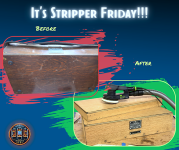
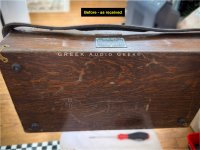
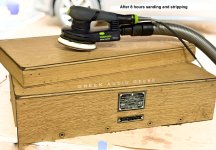
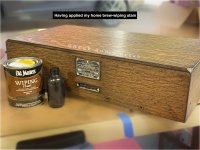
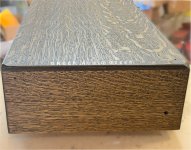
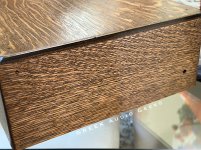
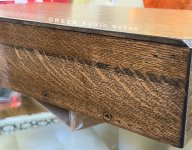
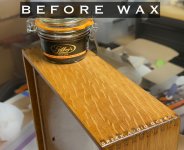
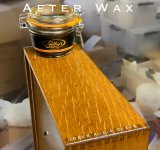
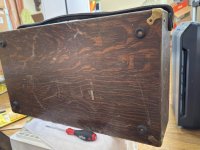
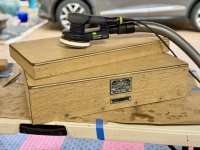
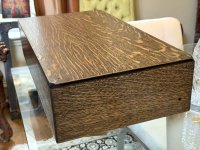
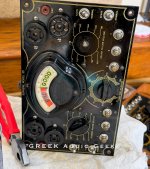
Here is the completely stripped 1940's US Navy tube tester I have with before and after photos.

Process:

- I first wipe with home-made solvent mixture to clean off the 85 years of grime;
- Then use 80 grit net abrasives to sand off much of the old finish. Regular sandpaper is useless;
- Apply and scrape off finish with several applications of Jasco finish stripper;
- Scrub several times with steel wool and solvent to clean off old stripper residue;
- Then spend 4-6 hours sanding it down with various grits of sand paper usually 80 grit, 120 grit, 150 grit and 180 grit;
- Then another scrub down with solvent and steel wool;
- Finally a final sanding with 180 net paper and a hand sand with the same 180 grit paper.

Now it's time to rest the back and arms and decide overnight which finish to apply tomorrow...

furniture refinish, woodworking.png
 
Here is the completely stripped 1940's US Navy tube tester I have with before and after photos.

Process:

- I first wipe with home-made solvent mixture to clean off the 85 years of grime;
- Then use 80 grit net abrasives to sand off much of the old finish. Regular sandpaper is useless;
- Apply and scrape off finish with several applications of Jasco finish stripper;
- Scrub several times with steel wool and solvent to clean off old stripper residue;
- Then spend 4-6 hours sanding it down with various grits of sand paper usually 80 grit, 120 grit, 150 grit and 180 grit;
- Then another scrub down with solvent and steel wool;
- Finally a final sanding with 180 net paper and a hand sand with the same 180 grit paper.

Now it's time to rest the back and arms and decide overnight which finish to apply tomorrow...

View attachment 35072
That yellow grained wood is gorgeous! Nice job indeed.
 
Back
Top