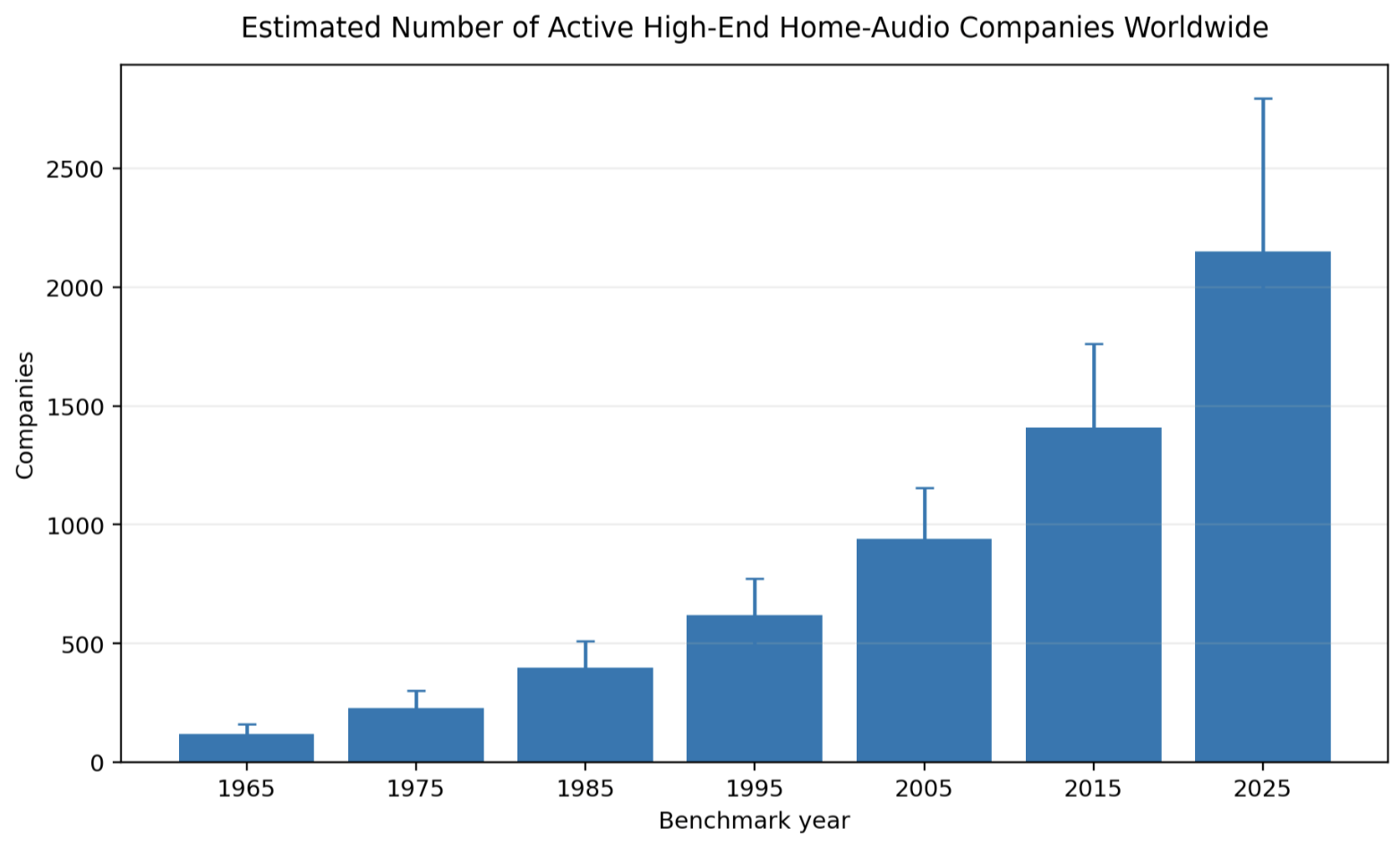
Like all modern day "articles", pick THE variable that makes the point I WANT and let the majority of lazy take it as copy and paste gospel. I have a much different take. This article raises more questions than it answers. No doubt growth of manufacturers has grown but has that really interpreted to the growth of end-user purchase.
My premise is the "inbred customer base" has grown by leaps and bounds, that "inbred" customer base made up of ever increasing # of manufacturers who need other manufacturers products, resellers, "in home resellers" (most wanting a system they can't afford rather any desire to actually sell; case in a point, a very vocal person on another website), reviewers getting industry accommodations on the web or in print, shows and then there are those new markets such as the "Asian Market" we all hear about. Remember a manufacturer makes the same or close to the same, whether a product is sold to an end-user, reseller, in home reseller, reviewer, etc.
Of course, the first variable being ignored by Martin is population growth in general and population growth of developing countries in particular.
This "Asian Market" has eerie similarities to the Japanese Market of the 80s. Those old enough to remember, the massive burst of Japan and Hong Kong markets and power led to one of the biggest economic expansions in modern day history only to see, a burst of those economies leading to one of the worst economic collapses, with the Japanese stock market only now 30+ years later recovering and their debt at historical highs. This "Asian Market" is a fickle market that is NOW burning Porsche and many more to follow
I think anyone posting here knows what "high end" means, without having to put a $ to it and Martin can use $500 but I say BULL to that number which artificially inflates reality.
The price inflation in this industry, has no parallel. Since the early 80s, COLA has grown 4.1x. While there are those who will look at other luxury market and say, OMG look at the prices, Porsche, Ferrari, Rolex, etc. prices have actually grown almost parallel with COLA since the early 80s despite all the current day tariffs, etc. While there aren't many products still around to use as a comparison in high end, there are some such as IRS (but take your pick) and an IRS costing 30K back in 1980 now cost just under a million. Yes, this is anecdote, but anyone who has been involved in this high end knows of the price inflation I am referring to.
There are those who will justify the "high end" pricing and market and say how much the more mainstream market benefits from the "trickle down" effect. I say that it's the HIGH END that is benefitting much more from the trickle up effect, using this cheap mainstream well developed market for their price inflated purposes. Few high-end manufacturers have any real "trickle down" unless you want to look at WADAX, etc. and say, hey you can get 50K DAC that gives you "almost as much" as their 300+K product. Tell the average person about a 50K DAC being a trickle-down product and watch the laughs.
There are those who will claims cost of manufacturing has increased. Actually, just the opposite. Years ago, cost of making a metal cage for an Audio Research to their specs, cost much more per unit referenced to COLA, than the best thick laser etched aluminum casing ubiquitous in today's markets. Same for just about every part used in speakers, amps, pre-amps, dacs, turntables, etc. I am not arguing that the product is not much better, just as our computers are massively better than years ago, but analogous to computers, cost of production is much lower than years ago. I understand "economies of scale" but as I illustrate, the number of worldwide aluminum laser etches, chip manufacturers, etc. has propagated to such extent that ALL are now benefiting from their proliferation. The more successful companies like MSB or Magico can purchase and bring some of this technology in house; a sign of how cheap these manufacturing processes have become that these companies can afford what was once a HUGE investment and unaffordable outlay, which should help mitigate price inflation rather exponential inflate it.
The demographics, particularly in well-known developed are aging males and while attendance at shows by this demographic at shows may be steady, what is outstripping their representation is the ever increasing "press" and manufacturers relative to the end-user. Most of these manufacturers are more concerned about releasing new products at shows, ensuring that reviewers have their products, etc. than they are about having them available for purchase by the typical end-user. I own one of these products, where the new products are everywhere at Vienna, in huge numbers while products announced 2+ years ago have yet to be delivered to us end-users. I use this example to illustrate the "inbred" demand that is outpacing what once was the primary concern, the end-user
Time will tell whether my hypothesis is right or wrong, but I worry that the growing inbred market, much of which is spawned by a fickle and unsustainable "Asian Market" is nothing but a house of cards, waiting for THE unforeseen event to bring it crumbling down. There will definitely be survivors like Magico, Wilson, CH, etc. but this massive growth of manufacturers Martin looks to as a healthy market, is in my opinion, nothing to do with real demand by the end-user but a multivariate inappropriately analyzed marketplace.
Just my perspective. Lots of details I left out, but a summary of and criticism of some of the variables Martin used and left out to make some legitimate points but also draw some, IMHO, unsubstantiate conclusions.


 www.theabsolutesound.com


 Interestingly, I do notice some of them upgrading from things like Wiim to Hi Fi Rose or from a receiver to better integrated. Much depends on the person, their passion, budget, other things the important thing I do see growth or some taking an upgrade path. Some have even tried power products.


