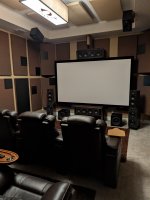
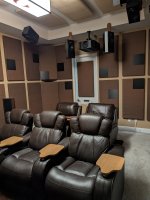
I am currently building a dedicated private cinema / 2 channel listening space. I designed the space for both 2 channel and immersive multichannel audio. The all-tube 2 channel system will be electrically isolated from the theater system. It is very tricky to design for both, and there are always compromises. The outcome will be dependent on how well I manage the compromises.
For immersive audio, the system will be Dolby Atmos focused and 9.4.6 This is the 15 speaker system described on page 148 of RP-22 with the addition of 4 subwoofers. For those not familiar with the lingo, that's 9 'bed layer' speakers : L, C, R, and two more wide screen wall speakers and 4 surround speakers, 9 total. Then 4 individually driven subwoofers and 6 Atoms height speakers. Thus 9.4.6. That's 19 discrete channels of audio.
I am designing the system to CTA RP-22:
CEDIA’s immersive audio design standard helps integrators achieve cinema-grade sound performance through acoustical precision, layout, and proven guidelines.

cedia.org
I am shooting for Level 3 performance, which is extremely difficult to pull off.
Level 4 is the rarified atmosphere of professional private cinema at the $5,000,000 and up price point.
2. I have taken senior level acoustical courses at university and own a MLSSA acoustical measurement system. I will DIY with professional help as needed. I will work with an acoustical materials supplier because figuring out the placement, size, and depth/# of cycles of diffusers requires computer software I don't have.
The room will be acoustically treated to achieve a balanced Rdt of 0.5 sec down to 100 Hz. Rdt will rise below that because it is almost impossible to add enough LF absorption to a normal room. I plan on using Trinnov Spherical Waveforming with 4 identical subwoofers symmetrically placed to reduce Rdt below 100 Hz. The rear subs are delayed and phase inverted to cancel the plane wave coming from the front.
To avoid over-damping the room at high frequencies, I will use an incremental approach to room treatment:
Design > implement > test > repeat.
3. For video, I will hire a professional calibrator who knows JVC projectors and has invested in the tens of thousands of dollars in spectrophotometers and spectroradiometers required to do an accurate calibration. If I find I'm not getting the audio performance I need, there are two professional audio calibrators that specialize in Trinnov systems. I won't hesitate to cry uncle and hire help.
The room is getting close to completion. Drywall is up and painted.