Michaels HiFi
Well-known member
- Thread Author
- #121
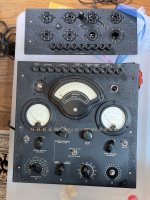
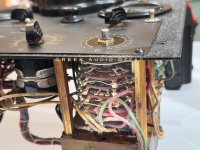
Here is a picture of 2 of the 3 tester modules and a picture of the 110 position switch. You can see why replacing it wasn't an option and I needed to do anything possible to get it un-seized.


That is the way to do it- just let it sit. I've freed a lot of stuff that way (I tend to work on a lot of vintage machines...).You were right. I haven't used it before and it really did work.
I unpacked the tester yesterday and it was still frozen solid. Figured I'd drop in a few drops overnight and I went to move it today so I could unpack the latest speakers I received.
I figured just for the heck of it I'd try it, never thinking it would work. I was stunned when it did! So I put in a few more drops and will let it sit over night.
Tomorrow I'll clean and lubricate it.

A consolidated chart for the 600Zounds that’s a beautiful tester! Not an old Hickok is it? And that switch you loosened up, just an absolute wow! Can’t be too many left for a spare I would suppose. I myself just picked up a Hickok 600A to test my type 45 tubes. I’m in the middle of familiarizing myself with it but it was just calibrated so I shouldn’t have any problems……………I hope.
Awesome advice. Thanks Ralph. I'll keep you updated on it.That is the way to do it- just let it sit. I've freed a lot of stuff that way (I tend to work on a lot of vintage machines...).
When you clean the switch: if you use DeOxit, the one to use is in the green, black and white spray can. Use it as sparingly as possible, since it can damage the phenolic material used to make the switch. The green and black can has a lubricant that stays pot, which is essential. If you use a 'control cleaner' that has no lubricant, it can be insanely easy to damage the switch and especially if its used in a potentiometer.
Do not attempt to use anything that requires a dropper or Qtip to apply. Such contact enhancers have chemistry that can migrate across the switch or control substrate to other contacts and have some conductive results, essentially ruining the part.
IOW, the DeOxit in the green and black spray can is as strong as you want to use, if longevity of the part is important!
I know, right? Imagine that back then it was wired all by hand!Michael, you know as I’m looking at that switch closeup I can’t help but think I could see it underneath a panel on the command module of a Saturn V rocket!
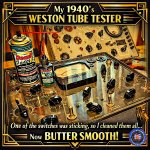
It's an old Navy Weston from 1941.Zounds that’s a beautiful tester! Not an old Hickok is it? And that switch you loosened up, just an absolute wow! Can’t be too many left for a spare I would suppose. I myself just picked up a Hickok 600A to test my type 45 tubes. I’m in the middle of familiarizing myself with it but it was just calibrated so I shouldn’t have any problems……………I hope.
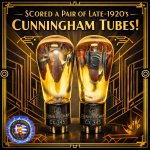
Are you able to test them yet?
 .
.
Yes, after the war the 4, 5 and 6 pin tube production was mostly for legacy equipment.Usually I don't go newer than WWII for USA tubes.
Hi Ralph,
Don't tell my wife, but I've actually received in the last week 16 vintage tubes from all over the world. I'm a little behind in getting them all cleaned and tested.
The "newest" ones are from the mid 50's which is usually to "new" for my tastes with many tubes, but I know those are good years for the French tubes I like and received.
Usually I don't go newer than WWII for USA tubes.
Those sound really nice.I had some RCA 'black plates' from the fifties that I absolutely loved
Those sound really nice.
But don't make the mistake of hearing Black Glass RCA's from WWII. There is no going back to the 60's or later after that.

 www.effectrode.com
Thanks for sharing! Love learning all I can.I could be wrong but I believe the RCA 'black plate' era did not begin until after WWII ? Regardless, it is pretty well accepted that the early fifties is when they became really popular.
here's a good article for those interested ...........
Black Plate Tubes - Effectrode