_theaudiofile
New member
- Joined
- Apr 13, 2026
- Messages
- 20
- Thread Author
- #1
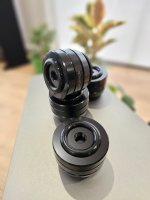
I’ve read about IsoAcoustics for years on various hi-fi forums. The praise seemed almost universal, but if I am being honest, the price gives me mild heart palpitations. Spending $499 AUD (~$350 USD) a pack just for accessories felt… well, steep to say the least. Spoiler alert and so I don’t scare you, these don’t just work, they work amazingly and definitely made a massive difference to my system. Definitely recommend!
For my setup, I had to get three packs: two for my pair of floorstanders and one for the subwoofer. Dropping a casual $1,497 AUD (~$1,050 USD) on speaker feet felt like a symptom of a severe mental illness. To put that into perspective, that is almost the exact amount of money I paid for my secondhand KEF Q950s. Spending almost the value of your actual speakers on the feet holding them up is a tough pill to swallow, and it involved some serious consideration before I could bring myself to pull the trigger.
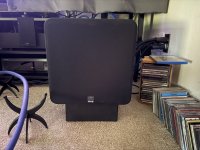
Adding salt to the wound, I’ve read critiques claiming these are just overpriced rubber pads, or that they strip away the warmth and "soul" of a speaker's low end. Still, my system was dealing with some annoying room boom, so I finally swallowed my pride and bit the bullet. These are the very first IsoAcoustics products I've ever owned. I hooked two sets up to my KEF Q950 floorstanders and the third set to my SVS PB-2000 subwoofer. Here is my deep-dive, honest, and slightly poorer first-time user impression.
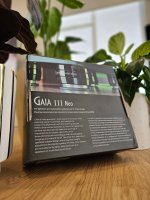
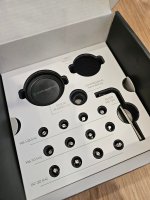
What’s in the Box:
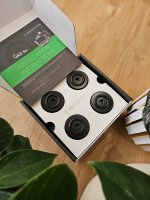
- 4 x GAIA III Neo Isolators (Machined Metal Housing)
- 4 x Dual-Surface Floor Sliders
- 4 x Adhesive Felt Pads (for hardwood protection)
- 4 x M6-1.0 Studs
- 4 x M8-1.25 Studs
- 4 x 1/4"-20 Studs
- 1 x Internal Wrench / Hex Tool
Specifications:
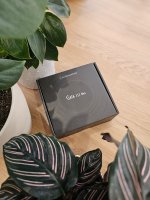
- Dimensions: 56mm wide x 45mm tall.
- Weight Capacity: Strict 32 kg (70 lbs) maximum per set of four.
- Height Adjustment: 8.5mm of tool-free vertical travel.
The Science:
Before dropping this kind of cash, I wanted to know exactly what I was paying for. For decades, the old-school hi-fi rule was to use sharp metal spikes to "ground" your speakers to the floor.
In actuality, this is quite the contrast. They act like a direct bridge, pumping all the messy vibrations from your speaker cabinet straight into the floorboards. This turns the entire room into a big, vibrating extension of the speaker, resulting in muddied sound.
The GAIA Neos use smart engineering to rectify this. Instead of anchoring the speaker to the floor, they completely isolate it using a special internal rubber-like suspension. It works like this:
- Absorbs front-to-back recoil: When your speaker cones pump forward and backward, the internal suspension catches and absorbs that kinetic energy.
- Stays stiff side-to-side: While it absorbs the front-to-back motion, it keeps the speaker solid laterally. This stops the cabinet from swaying, keeping your soundstage sharp.
Setup & Aesthetic:
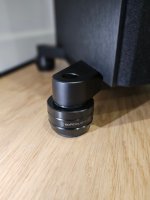
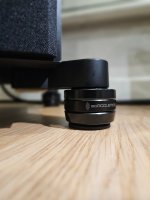
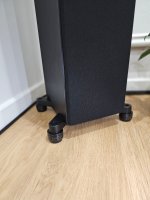
The GAIA III Neo comes in two finishes: a reflective Dark Chrome or Black. I wanted the feet to be discreet and blend into the bases of my speakers, so I opted for the Black.
One of the complaints I read about the older, first-gen GAIAs was how difficult they were to install; people disliked wrestling with tiny spanner wrenches and tedious two-part jam nuts that shook loose. Thankfully, since these are the new Neo versions, IsoAcoustics overhauled the design:
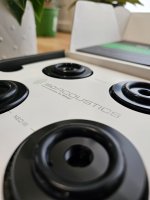
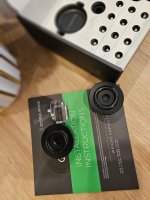
- The Compressed O-Ring: The top of the metal housing features a thick, integrated rubber O-ring. You thread the included M8 stud into the bottom of the speakers and screw the GAIA Neo body on until it sits flush against the cabinet base. The compressed O-ring acts as its own high-friction lock. No tools needed, super simple.
- On-the-Fly Leveling: My floors aren't perfectly level, but adjusting height on these is very intuitive. There is an independent silver lower collar ring you can twist to adjust the height up to 8.5mm on-the-fly without needing to spin the entire footer casing.
- The Floor Sliders: Moving heavy hi-fi gear around usually risks a slipped disc or a ruined floor. Slipping the included Dual-Surface Floor Sliders under the heavy Q950s allowed me to glide them around the room to find the perfect listening spot before tilting the cabinets back to remove the discs.
Sizing & Customer Service:
When buying something this specific, you worry about getting the wrong size, thread pitch, or weight class. IsoAcoustics has a Product Selector tool on their website. You just type in your exact speaker and subwoofer models, and it spits out the perfect matching GAIA model and the thread size required.
Even with the website calculator doing the math, dropping nearly $1,450+ AUD makes you want absolute certainty. So, I reached out to their customer support team.
I have dealt with a lot of customer service, but if I’m being honest without overselling it, I would easily give their team a 10/5 if I could. They went above and beyond to ensure everything would be an absolute perfect match for my setup. We went back and forth via email, sending pictures of my gear, checking the base plates, and double-, triple-, and quadruple-checking the exact M8 thread depths so that installation day would go seamlessly. And it did.
For the price, you get amazing physical product, but you're also getting the absolute best-of-the-best customer care on the market. I hate to include this as part of the review, but having experienced their customer service, it would be a disservice to IsoAcoustics if I didn’t recognize their quality of service here.
Sound Impression:
When you decouple a speaker, the drivers stop fighting the reflections of their own vibrations bouncing back up from the floorboards. The speaker drivers are finally allowed to operate in a much more linear, stress-free fashion, resulting in a cleaner presentation across the entire frequency range.
On the KEF Q950 Floorstanders
The most immediate change was that the low end felt like it went on a strict diet. Standard spikes were letting the speakers vibrate the flooring, creating a heavy, warm, and honestly pretty muddy bloom. With the GAIA pads under them, that vague low-frequency drone disappeared. Instead of a generic wall of bass, you can actually hear the distinct note decay and texture of a bass guitar string.
Because the floorboards stopped humming along, the midrange cleared up beautifully. Vocals instantly snapped into a sharp, lifelike center focus, staying cleanly separated from the instruments even when the music got loud and chaotic.
What really surprised me was the hidden "micro-detail" that woke up. Because the structural floor hum was gone, I could suddenly hear the faint, natural echo of the recording studio and the subtle way acoustic instruments faded out. The whole presentation sounded less harsh and much more relaxed, without losing dynamic punch.
On the SVS PB-2000 Subwoofer
The PB-2000 is a powerful, ported sub that used to make things rattle all over the room. Decoupling it completely stopped the floorboards from joining in on the track as an uninvited instrument.
The sub-bass now hits with massive, clean, localized authority. It feels tighter and punches harder simply because it is rising out of a completely silent background rather than vibrating the physical structure of the room. You get the deep visceral slam in your chest, but without the annoying house rattle.
Conclusion:
A lot of people in the hi-fi community would argue that this kind of money ($1,497 AUD / ~$1,050 USD total) is better investing in higher-end speaker upgrade; I don’t necessarily disagree with that logic. When I first discovered the GAIA series and realized the investment would match what I spent on my actual speakers secondhand, the price tag drove me away for that exact reason.
But after taking the gamble, physically trying them in my space, and hearing the real difference they made to my actual listening experience, I am convinced. If your system is already performing at a high level and you want to extract every bit of potential out of your gear without your room getting in the way, these are a fantastic value product well worth investing in. Your wallet will hurt initially, but your ears will thank you.