Class D if so inclined

a.wayne

Well-known member
Joined
Apr 19, 2015
Messages
3,813
Location
Front Row Center
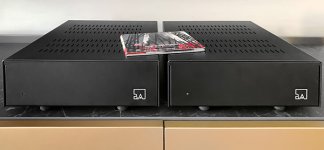
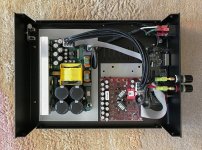
These measured very well and at what is very reasonable cost wise, if looking at class D i would absolutely give these a shot …


Regards

 
There are now lots of great Class D amps but you still have to be wary of buying cheap stuff from Ebay, etc.
 
Aren't most Class D amps considered "cheap stuff"?
Those who think that are misguided.

True 10-15 years ago but the best modern Class D will give other Classes a run for twice their money. I home auditioned 12 ss amps of various Classes in the £3-8K range and chose a Class D to replace costly SETs. No regrets and audiophile visitors are always impressed.
 
Those who think that are misguided.

True 10-15 years ago but the best modern Class D will give other Classes a run for twice their money. I home auditioned 12 ss amps of various Classes in the £3-8K range and chose a Class D to replace costly SETs. No regrets and audiophile visitors are always impressed.

Well, you went from SE amps that are distortion generators to low distortion amps so that is a big change in itself.
 
Well, you went from SE amps that are distortion generators to low distortion amps so that is a big change in itself.
True, but having decided for various reasons to look for a ss amp that would provide as good and exciting a rendition of music as the SETs (but not to mimic the features of SET), I embarked on a year-long audition session with numerous amps from many well-known and several obscure brands before choosing the Class D one. It was surprising how much difference there was in these amps and more so that some amps that were expected to excel, fell well short of expectations.

A bit of the right sort of distortion doesn't spoil the listening experience and this was not a consideration - it was simply the pleasure that listening to music gives the listener, irrespective of measured performance.
 
True, but having decided for various reasons to look for a ss amp that would provide as good and exciting a rendition of music as the SETs (but not to mimic the features of SET), I embarked on a year-long audition session with numerous amps from many well-known and several obscure brands before choosing the Class D one. It was surprising how much difference there was in these amps and more so that some amps that were expected to excel, fell well short of expectations.

A bit of the right sort of distortion doesn't spoil the listening experience and this was not a consideration - it was simply the pleasure that listening to music gives the listener, irrespective of measured performance.

Understood. What was the price range of the amps you auditioned before you bought the Class D amps?
 
Understood. What was the price range of the amps you auditioned before you bought the Class D amps?
£3-8K and included amps from Mark Levinson, Accuphase, Sugden, Quad, GamuT, NAD, Lyngdorf, Benchmark and a few obscure brands thst were recomened for use with my speakers,
 
Not all Class D is inexpensive, Merrill Audio, Jeff Rowland, Levinson #53 monoblocks, $10k for the MyTech I don't consider cheap, to mention a few.

What would be interesting is a listening test between the older #53 amps and something like the current Orchard Audio GAN monoblocks. Or, just older high dollar vs. current Class D. The 53's are beasts I should have checked as to what area is Class D
 
Not all Class D is inexpensive, Merrill Audio, Jeff Rowland, Levinson #53 monoblocks, $10k for the MyTech I don't consider cheap, to mention a few.

What would be interesting is a listening test between the older #53 amps and something like the current Orchard Audio GAN monoblocks. Or, just older high dollar vs. current Class D. The 53's are beasts I should have checked as to what area is Class D

You can make anything expensive. That's why we have $10k power cords and thousands of dollars for power cord bras to hold them in place.
 
Not all Class D is inexpensive, Merrill Audio, Jeff Rowland, Levinson #53 monoblocks, $10k for the MyTech I don't consider cheap, to mention a few.

What would be interesting is a listening test between the older #53 amps and something like the current Orchard Audio GAN monoblocks. Or, just older high dollar vs. current Class D. The 53's are beasts I should have checked as to what area is Class D
ML 53’s were class D ..? Not aware ..

Edit:
Just as i recalled not Class D ..!

 
@Hear Here ,

What topology drives the bass units? IMO you should use the same for the horns for best integration..
Bass units in the Duo XD have twin 500 watt Class D amps for the 12" drivers. Latest Duo GT uses a single 1000 watt amp that powers both drivers. Impedence of both systems is 18 ohms.

I use Class D for the system as a whole, though all trechnologies work equally well. I guess your theory applies to conventional speakers with subs, though I don't agree that Class D is any more suitable for the mains than any other class, even though the subs are likely Class D.
 
Using all class D will give your system a single voice and much better for integration. When used with tubes for eg the integration will be odd ..
 
Using all class D will give your system a single voice and much better for integration. When used with tubes for eg the integration will be odd ..
Hi - so in your experience do all Class D amps sound the same that will enable people to get "same voice" with a sub? So would the Class D amp on an SVS sub be voiced and sound the same as one of Ralph's class D amps?

Of all the Class D I've heard there is a very wide difference in their sound.

Also many powered subs are class D. I've heard many that integrate very well with various classes of amps.

It would seem that it's more a matter of crossover type, frequency, sub placement, etc. that would dictate how it blends and integrates sound-wise more than simply "all class D". Would you agree?
 
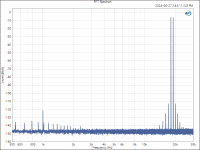
Just read the follow up. Those amps as tested with the new tweaks are incredible performers. If you really want to know how an amp performs, look at the 19 kHz and 20 kHz two-tone IM. This amp is -120 dB!

Here is the two tone imd for the Electroacompianet 300 M monoblock retailing for $30,000. It is 10 dB worse than the Buckeye. For 20x the price.

1763917544332.png
 
ML 53’s were class D ..? Not aware ..

Edit:
Just as i recalled not Class D ..!


You are splitting hairs, they call it ClassI but it's still a switching amp. Still not one of the under 20 pound items like today. And, unique to any other Levinson amp.
The No.53 uses what Mark Levinson calls a patented, multistage "very high speed switching amplifier technology," Interleaved Power Technology (IPT), which is claimed to offer significant advantages over prior switching-amp topologies.


In a conventional class-D amplifier, one output transistor connects the output to the positive voltage rail, another connects it to the negative voltage rail. It is very important that when one transistor is turned on, the other must be turned off and vice versa, otherwise the positive and negative voltage rails will be short-circuited and the amplifier will self-destruct. However, because one transistor will be turned off before the other is turned on, there will be a short period of "dead time" when neither is turned on. This is analogous to crossover distortion in a conventional class-B amplifier.


ML's engineers set out to develop a new PWM output stage designed to overcome these limitations. The transistors switching the positive and negative voltage rails to the load in Levinson's "class-I" topology are each connected to the load via a large air-cored inductor and to the opposite voltage rail via a diode. The result is a stable amplifier with an effectively doubled switching frequency. Modulating the duty cycle of the 500kHz switching frequency of each transistor results in a 1MHz PWM output signal but without producing anything like the usual amount of ultrasonic noise. So minimal are the ultrasonic artifacts in the No.53's output, it is claimed, that, rather than requiring a sonically degrading brick-wall filter, all that's needed to remove them is a simple notch filter.


The No.53 uses four interleaved class-I/IPT stages in a balanced bridge configuration, to produce an effective PWM switching frequency of 4MHz. This allows the No.53's signal bandwidth to be extended to 100kHz.


Four Subsections

 
Back
Top